

























Definition of the FAS Incoterm (Free Alongside Ship)


Quick Overview
FAS (Free Alongside Ship) is an Incoterm used exclusively for maritime or inland waterway transport. The seller must deliver the goods alongside the ship at the agreed port of shipment, assuming all costs and risks until that point, but not loading them on board. Under Incoterms 2020, the seller is also responsible for export clearance.
FAS explained in 30 seconds
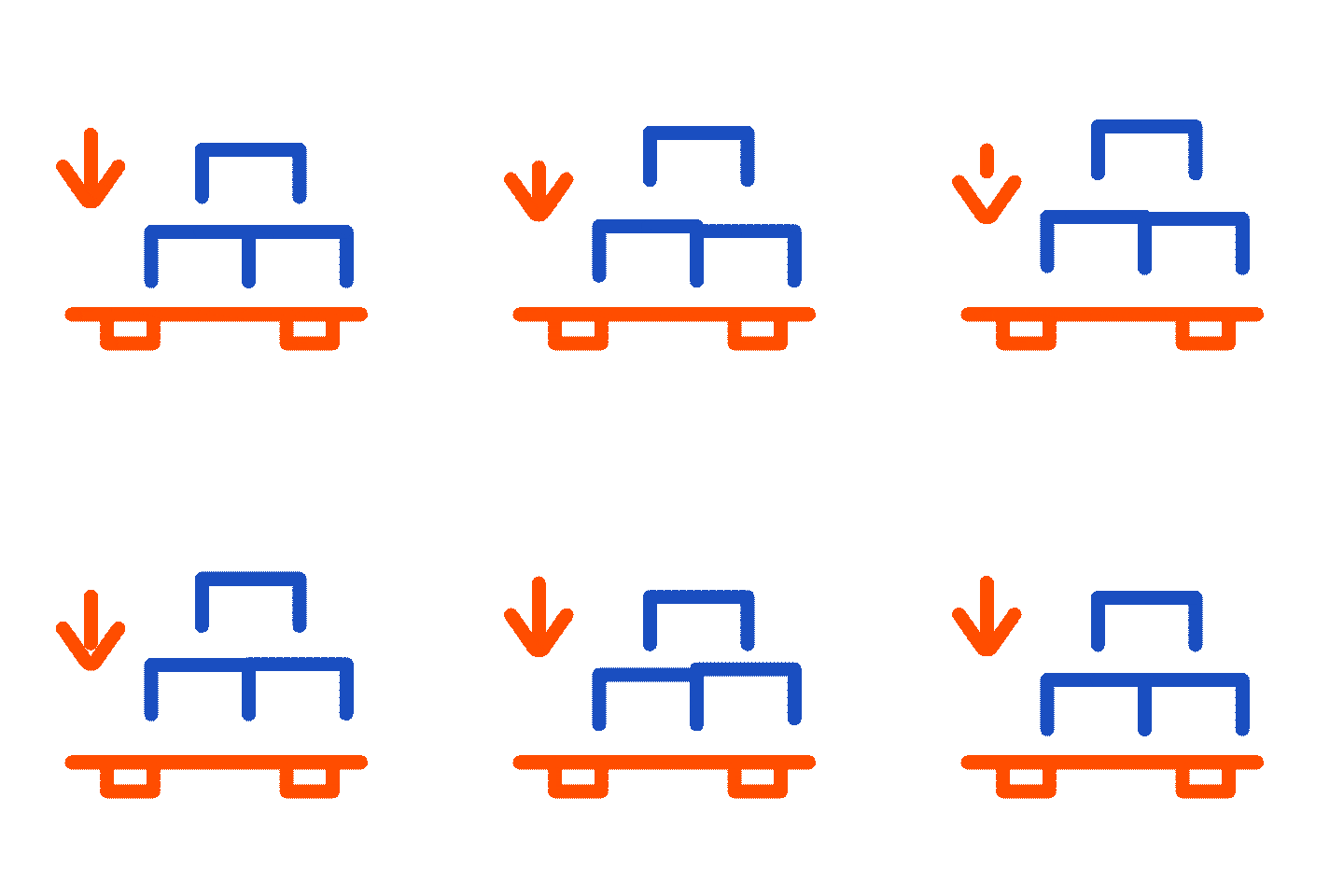
See how FAS divides export clearance, delivery alongside the vessel, loading, ocean transportation and risk between the seller and buyer.
Seller's Obligations (FAS)
- Prepare the goods: packaging, labeling, and inspection
- Transport and deliver the goods alongside the ship at the dock or terminal
- Handle export customs clearance and related costs
- Provide contractual documentation and notify the buyer of delivery
Buyer’s Obligations (FAS)
- Pay for the goods according to the contract
- Assume costs and risks once the goods are placed alongside the ship
- Arrange international ocean freight
- Cover departure port charges (if not paid by the seller)
- Handle import customs clearance, including duties, taxes, and VAT
- Organize inland transport to the final destination in the destination country
Worked Example: Oversize Project Cargo under FAS
Scenario. A Spanish wind-turbine manufacturer sells a $120,000 wind-turbine blade (single oversized breakbulk piece, 60 m long) FAS Bilbao Quay 5 to a US wind farm developer; ocean to Galveston. FAS = Free Alongside Ship; seller delivers cargo to the dock next to the named vessel; buyer takes over for loading + ocean + everything after.
| Cost line | Pays | Range (USD) |
|---|---|---|
| Cargo (FAS invoice) | Buyer | $120,000 |
| Origin inland transport: Bilbao plant → Quay 5 | Seller | $2,400–$3,800 — oversize permit and escort |
| Quay handling fees: Bilbao | Seller | $650–$980 — Source: Port of Bilbao tariff 2026 |
| Loading onto vessel: oversize crane lift | Buyer | $3,500–$5,500 — Source: heavy-lift specialist quote, H1 2026 |
| Ocean freight: Bilbao → Galveston, breakbulk/oversize | Buyer | $28,000–$42,000 — Source: BBC Chartering / Spliethoff project rate band, H1 2026 |
| Optional cargo insurance for the buyer’s risk after delivery alongside the vessel | Buyer, if it chooses to obtain cover | $960–$1,800 — illustrative premium |
| Destination handling: Galveston and oversize permit transport | Buyer | $4,500–$7,200 |
| Seller’s stack (FAS) | — | $3,050–$4,780 |
| Buyer’s stack (post-quay) | — | $36,960–$56,500 |
This example assumes that the buyer chooses to insure its risk after the goods are delivered alongside the vessel. FAS itself does not require either party to obtain cargo insurance. The buyer’s example total includes this optional insurance premium; the amount payable will depend on the actual quotation and coverage selected.
FAS use case: bulk cargo or oversize project cargo where loading onto the vessel is itself a major operation that the buyer's project team controls. Containerized cargo should use FCA, not FAS.
Footnote: Wind-turbine blade transport is a niche heavy-lift / project-cargo market; quoted oversize ocean rates are project-specific spot quotes, not index-driven. The figures above are 2025-2026 market bands for similar lengths/routes from BBC Chartering, Spliethoff, AAL Shipping spot quotes — refresh per project.
Insurance under FAS
FAS does not require the seller or buyer to obtain cargo insurance.
The seller bears cargo risk until the goods are delivered alongside the buyer-nominated vessel at the named port of shipment. The buyer normally bears the risk from that point, including loading aboard the vessel and the subsequent journey.
Each party should consider insurance for its own risk. Alternatively, the parties may agree that one of them arranges coverage for the complete movement. Confirm that the policy covers the intended stages and handling operations, subject to its terms and exclusions.
Specify the insurance arrangement separately in the sales contract. If the buyer obtains cover for its FAS exposure, it should begin at the agreed alongside-delivery point rather than only after vessel loading.
Why is FAS not suitable for containerized cargo?
- FAS requires goods to be physically delivered next to the vessel, not to a terminal or in a container
- In container shipping, containers are usually delivered to logistics terminals days before loading
- Therefore, FAS is intended for breakbulk, bulk, liquid, or heavy cargo that can be delivered directly to the dock
- For container shipments, the FCA Incoterm is more appropriate, as it allows for delivery at terminals or other pre-shipment points, and defines the risk transfer point more clearly
FAS vs FOB - Sea-only Incoterms with Different Risk Transfer Points
FAS and FOB are the two "F-group" Incoterms restricted to sea and inland waterway transport. The difference is the moment of risk transfer: alongside the ship (FAS) versus loaded on board the vessel (FOB).
| Attribute | FAS (highlighted current term) | FOB |
|---|---|---|
| Mode of transport | Sea / inland waterway only | Sea / inland waterway only |
| Risk transfer point | When goods are placed alongside the vessel at named port | When goods are loaded on board the vessel at named port |
| Loading on board | Buyer's responsibility | Seller's responsibility |
| Best fit | Bulk, breakbulk, heavy lift, project cargo where the buyer's stevedores load the vessel | Bulk and breakbulk where the seller can load on board; not recommended for containerized cargo |
Sources and References
- ICC – International Chamber of Commerce: Incoterms 2020 Rules Official source for the Incoterms® 2020, explaining the rules, including FAS and its scope of application.
- International Trade Administration (U.S.): Know Your Incoterms A U.S. government guide describing each Incoterm, including FAS, and its role in international trade agreements.
- Trade Finance Global: Incoterms® 2020 Guide Comprehensive commercial guide that breaks down each Incoterm, including suitability for cargo types like containers and breakbulk.
- IncoDocs: Incoterms 2020 Explained – The Complete Guide Visual and practical guide explaining the purpose, use cases, and limitations of FAS and other Incoterms.
- ICC Academy: Incoterms® 2020 and Risk Management Educational article exploring how risk transfers under terms like FAS, and why containerized cargo may not align well with it.
- 1. Quick Overview
- 2. FAS explained in 30 seconds
- 3. Seller's Obligations (FAS)
- 4. Buyer’s Obligations (FAS)
- 5. Worked Example: Oversize Project Cargo under FAS
- 6. Insurance under FAS
- 7. Why is FAS not suitable for containerized cargo?
- 8. FAS vs FOB - Sea-only Incoterms with Different Risk Transfer Points
- 9. Sources and References
Related Articles


