

























20ft Container Dimensions, Capacity and Weight


Quick Overview
A standard 20ft dry container provides about 33 cubic meters of internal space. To check whether your shipment fits, compare its packed dimensions and weight with the container’s interior, door opening and permitted load. Cubic capacity alone does not confirm that cargo can be loaded.
20ft container dimensions at a glance
The 20ft designation identifies the container size class. The measurements below describe one carrier’s equipment example; they are not guaranteed dimensions for every container supplied.
| Specification | Metric | Imperial |
|---|---|---|
| Internal length | 5.900 m | 19 ft 4¼ in |
| Internal width | 2.352 m | 7 ft 8⅝ in |
| Internal height | 2.395 m | 7 ft 10¼ in |
| Door opening width | 2.340 m | 7 ft 8⅛ in |
| Door opening height | 2.292 m | 7 ft 6¼ in |
| Internal cubic capacity | 33.2 m³ | 1,172 ft³ |
| Empty container weight, or tare | 2,350 kg | 5,181 lb |
| Maximum gross weight | 30,480 kg | 67,197 lb |
| Maximum payload | 28,130 kg | 62,016 lb |
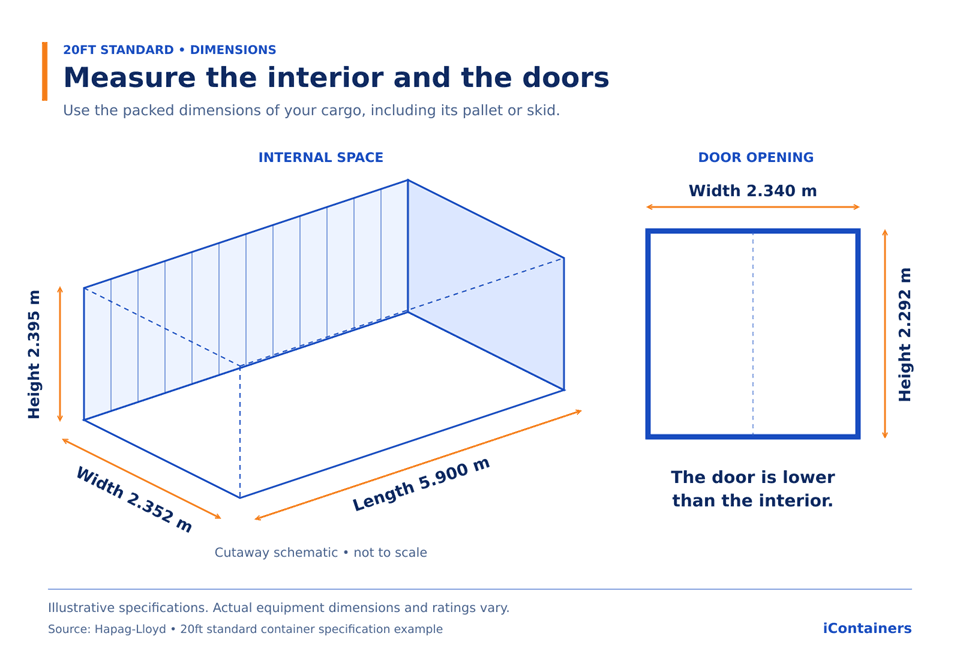
Source: Hapag-Lloyd’s 20ft standard container specifications. Equipment varies by manufacturer. Confirm the allocated unit’s dimensions, plate ratings and transport restrictions before finalizing the load.
How much fits in a 20ft container?
Internal volume is the space inside an empty container. The cargo you can actually load depends on package shapes, pallet footprints, stackability, securing materials and the space needed to move goods through the doors.
For example, 20 hypothetical crates measuring 1.20 × 1.00 × 1.00 m each total 24 m³. That total is below the example container’s cubic capacity, but it does not establish a workable layout. The crates must also fit across the floor, stack safely if stacking is needed, and remain within the permitted weight.
Measure packages after packing, including pallets, protective packaging and any overhang. A package that fits within the internal height may still be too tall for the lower door opening.
How many pallets can you load?
Pallet count depends on the exact base dimensions, orientation and loaded footprint. Do not treat a quoted pallet count as a guarantee: overhanging cartons, non-stackable goods and loading clearance can change the result. Use a floor plan based on the actual loaded pallets, and check the pallet capacity guide for layout considerations.
What cargo suits a 20ft dry container?
A 20ft dry container can suit packaged goods that need an enclosed container without temperature control. It can also be worth comparing for dense cargo, where the weight limit may be reached before the available space is filled.
For machinery, concentrated loads or unusual shapes, provide the packed dimensions, individual piece weights and loading method before booking. Temperature-controlled cargo requires suitable refrigerated equipment; the dry-container dimensions on this page do not describe a reefer.
Tare, payload and maximum gross weight
These terms measure different things:
- Tare: the empty container’s weight.
- Payload: the weight loaded into the container, including cargo and its packing and securing materials.
- Gross weight: the container and its contents together.
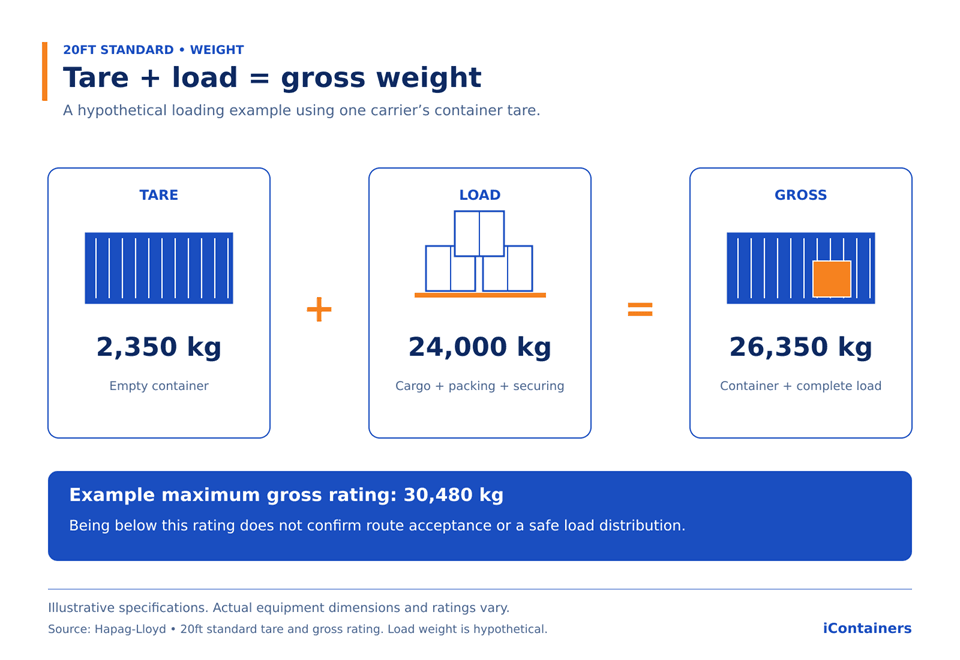
For the carrier example above, 30,480 kg maximum gross weight minus 2,350 kg tare gives a 28,130 kg payload rating. This equipment rating does not automatically establish the weight accepted for every inland movement.
Hypothetical weight example: if the entire load, including packing and securing materials, weighs 24,000 kg, adding the example tare gives a gross weight of 26,350 kg. The shipment is below that example container’s maximum gross rating. The carrier and inland transport provider must still confirm acceptance, load distribution and applicable route or equipment restrictions.
Do not assume a 40ft container can carry twice the cargo weight simply because it has more space.
Should you choose a 20ft, 40ft or High Cube container?
| Option | Main reason to compare it | What to check |
|---|---|---|
| 20ft standard | Your load needs a smaller dedicated container | Floor layout, payload and the total quote |
| 40ft standard | You need more floor space and cubic capacity | Cargo dimensions, handling and available equipment |
| 40ft High Cube | Extra height may help with taller or stackable goods | Door clearance and whether the load can use the height |
A standard-height container is nominally 8 ft 6 in tall externally; a High Cube is 9 ft 6 in tall. The extra height does not give a 40ft High Cube more floor length than a 40ft standard container. See the carrier’s general-purpose and High Cube equipment descriptions.
Use the 40ft standard guide or 40ft High Cube comparison for the relevant measurements.
What affects the cost of shipping a 20ft container?
Request a quote for your origin, destination, cargo-ready date and service requirements. Compare the ocean rate together with applicable pickup, terminal, documentation, customs-service and delivery charges. Check which items are included, which are excluded and how long the rate remains valid.
Also confirm whether your cargo needs special handling and what loading, unloading or equipment-return arrangements apply. Compare 20ft and 40ft options for the same shipment and service scope; there is no universal volume or weight at which one always becomes cheaper.
Should you book a full container or shared space?
With FCL, your shipment has exclusive use of the container even when it is not completely full. With LCL, your goods share container space with other shipments.
Compare both options when your load could reasonably use either service. Consider the complete price, consolidation and destination handling, schedule and delivery arrangements. A shipment’s CBM helps define the quote, but does not establish a universal FCL/LCL crossover point. Read the FCL vs LCL guide for a fuller comparison.
Prepare your shipment for loading
Give the loading team a packing list with package dimensions, weights and stacking limitations. Agree on the equipment needed to load and unload, the weight distribution and the securing plan. Confirm access and receiving arrangements at each site.
If cargo is close to a door-opening or weight limit, ask for confirmation against the actual equipment before dispatching it for loading.
Where the 20-ft Comes from: the TEU Standard
The 20-ft container is the basis of the TEU (twenty-foot equivalent unit), the standard measure of vessel and port capacity.
- 1. Quick Overview
- 2. 20ft container dimensions at a glance
- 3. How much fits in a 20ft container?How many pallets can you load?
- 4. What cargo suits a 20ft dry container?
- 5. Tare, payload and maximum gross weight
- 6. Should you choose a 20ft, 40ft or High Cube container?
- 7. What affects the cost of shipping a 20ft container?
- 8. Should you book a full container or shared space?
- 9. Prepare your shipment for loadingWhere the 20-ft Comes from: the TEU Standard
Related Articles


