

























40ft High Cube Container Dimensions, Capacity and Weight


Quick Overview
A 40ft High Cube dry container offers extra height for cargo that can benefit from more vertical space. Its nominal external height is 9 ft 6 in, compared with 8 ft 6 in for a standard container. It has the same nominal length and width as a standard 40ft container. See OOCL’s High Cube description.
Before booking, check the interior, door opening and weight rating separately. Extra internal height is useful only if your packed cargo can pass through the doors and be loaded, stacked and secured as planned.
40ft High Cube container dimensions
The nominal external size is 40 × 8 × 9 ft 6 in, approximately 12.19 × 2.44 × 2.90 m. Nominal exterior dimensions do not describe the space available to your cargo.
The following internal measurements and weights come from Hapag-Lloyd’s published equipment example.
| Specification | Metric | Imperial |
|---|---|---|
| Internal length | 12.032 m | 39 ft 5⅝ in |
| Internal width | 2.350 m | 7 ft 8½ in |
| Internal height | 2.700 m | 8 ft 10¼ in |
| Door opening width | 2.340 m | 7 ft 8⅛ in |
| Door opening height | 2.597 m | 8 ft 6¼ in |
| Internal cubic capacity | 76.3 m³ | 2,694 ft³ |
| Empty container weight, or tare | 3,900 kg | 8,598 lb |
| Maximum gross weight | 32,500 kg | 71,650 lb |
| Maximum payload | 28,600 kg | 63,052 lb |
Source: Hapag-Lloyd’s 40ft High Cube specifications, using its tabulated measurements. Dimensions and ratings vary between equipment models. Confirm the allocated container and the shipment’s transport limits with the carrier.
40ft standard vs 40ft High Cube
| Measurement | 40ft standard | 40ft High Cube |
|---|---|---|
| Nominal external height | 8 ft 6 in / approximately 2.59 m | 9 ft 6 in / approximately 2.90 m |
| Example internal length | 12.032 m | 12.032 m |
| Example internal height | 2.395 m | 2.700 m |
| Example door height | 2.292 m | 2.597 m |
| Example cubic capacity | 67.7 m³ | 76.3 m³ |
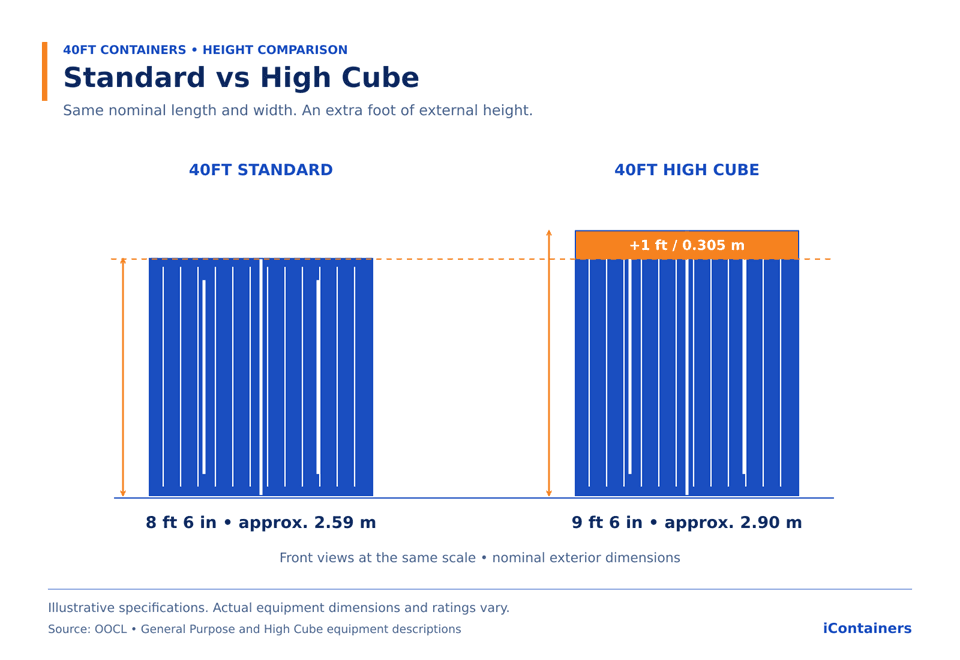
Internal measurements: Hapag-Lloyd’s 40ft standard and High Cube examples. Nominal external heights: OOCL’s general-purpose and High Cube equipment descriptions.
Calculated from these capacity examples, the High Cube provides 8.6 m³, or about 13%, more internal volume. That is a comparison of these two examples, not a fixed percentage for every container model.
The main benefit is vertical space. A High Cube does not automatically accommodate more pallets on the floor or more cargo weight. Compare the standard 40ft guide if your shipment does not need the extra height, or the 20ft guide if a smaller dedicated container may be sufficient.
How much cargo fits in a 40ft High Cube?
The internal volume describes the empty container. Actual loading capacity depends on the packed dimensions, layout, securing materials and the cargo’s ability to stack.
Extra height can accommodate a taller stack only when the packages and pallets are designed to support it. Non-stackable cargo may leave much of the upper space unused. For floor-loaded pallets, plan from the actual pallet footprint and overhang rather than assuming that a High Cube holds more pallets than a standard 40ft container.
Prepare a layout that allows loading and unloading as well as securing the goods. Use the pallet loading guide for further planning, and the CBM calculator to total packed volume. A volume calculation is not a loading plan.
How much weight can a 40ft High Cube carry?
Payload is the weight placed inside the container, including cargo, packaging and securing materials. Maximum gross weight includes the empty container as well. The example above has a 28,600 kg payload rating, calculated as 32,500 kg maximum gross minus 3,900 kg tare.
Use the actual container’s marked rating and confirm the weight accepted for the complete transport movement. The available inland equipment, load distribution and route restrictions can affect what can be carried.
More cubic capacity does not establish a higher permitted payload. Dense goods can reach a weight limit while much of the space remains empty.
When is a High Cube worth comparing?
A High Cube can be useful for tall packaged items or bulky, relatively light goods. Furniture, appliances and stackable cartons are possible examples, provided their packed dimensions and handling requirements suit the container.
Ask these questions before choosing:
- Does the packed cargo need the extra height, including its pallet or skid?
- Can it pass through the door opening with enough handling clearance?
- Can the shipment safely use the upper space through stacking?
- Can the pickup and delivery arrangements accommodate the required equipment?
Compare standard and High Cube quotes for the same route, date and service scope. Equipment availability and the quoted charges determine the price difference; do not assume a fixed surcharge or saving.
This guide covers dry equipment. Cargo requiring temperature control needs a suitable reefer, whose interior and operating requirements differ.
Check the door opening before the internal height
Hypothetical example: a crate measures 2.50 m high, including its skid, and must remain upright. It exceeds the 2.292 m standard-container door height in the comparison above. It is below the example High Cube door height of 2.597 m, leaving 97 mm of nominal vertical clearance.
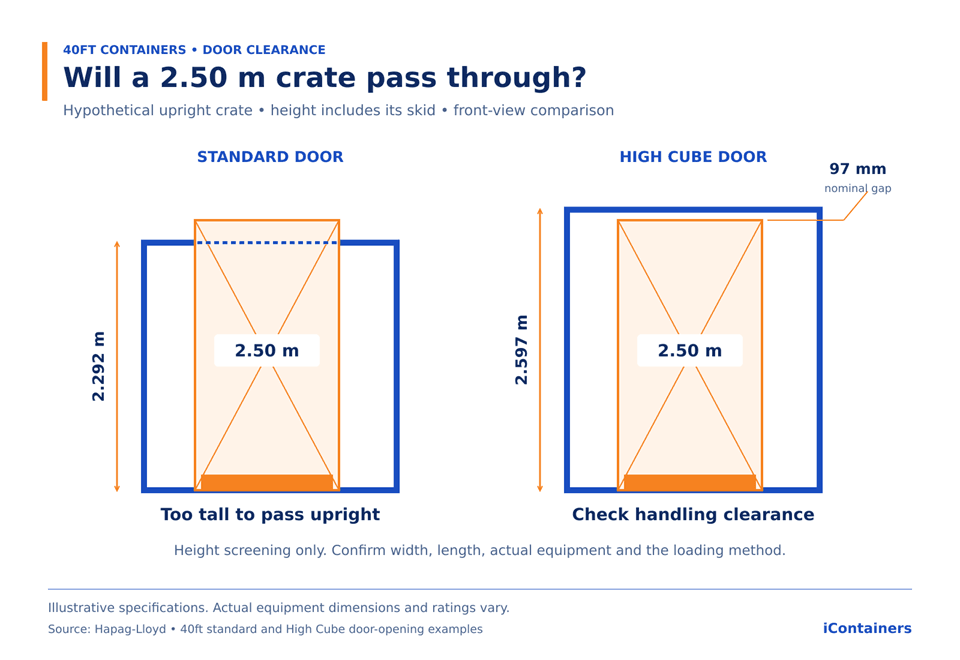
That calculation is only an initial screening check. Confirm the crate’s width and length, the exact container, the handling equipment and the clearance needed during loading. A forklift or other handling method can require additional space. The example does not guarantee acceptance or fit.
Carrier variation can matter: OOCL’s High Cube example lists a 2.585 m door height. Use the specification of the equipment actually supplied when cargo is close to a limit.
Get a quote for your High Cube shipment
Prepare the origin and destination, cargo-ready date, commodity, package count, packed dimensions and gross cargo weight. Include stackability, any unusually tall pieces and the planned loading and unloading arrangements.
For a dedicated container, ask about 40ft High Cube availability and the complete FCL service scope. If you are comparing shared space, provide the package details so the forwarder can assess suitable LCL service; an LCL booking does not give you exclusive use of a High Cube container.
Compare ocean freight options or read the FCL vs LCL guide.
Frequently Asked Questions about 40ft High Cube Shipping Container
A 40-foot high cube container offers an additional foot of vertical space compared to a standard 40-foot container. While standard units measure 8 feet 6 inches in height, high cube containers stand at 9 feet 6 inches. This added height increases internal volume by approximately 10%, making it suitable for taller or more voluminous cargo without altering the container’s length or width.
A 40 ft high cube container has a total internal volume of about 76.4 cubic meters (2,694 cubic feet). Depending on the cargo type and packaging method, it can hold:
- 25–27 Euro pallets or 20–22 standard pallets
- Up to 60,000 lbs (27,000 kg), subject to local transport regulations
- Bulky or irregularly shaped items that benefit from vertical clearance
These containers are ideal for goods that require extra height or efficient stacking, such as:
- Furniture and home appliances
- Industrial equipment and machinery
- Palletized, stackable products
- Lightweight bulk items (e.g., textiles, paper)
- Vehicles or oversized items
Always ensure proper weight distribution to comply with road transport limitations.
The extra foot of space allows you to:
- Stack items higher, reducing unused space
- Fit taller goods without modifying them
- Consolidate more cargo into a single shipment
Proper securing and balance are essential to prevent cargo shifting during transit.
To use the space efficiently:
- Use stackable pallets to take advantage of vertical space
- Place heavier items on the bottom, lighter ones on top
- Ensure even weight distribution to prevent imbalance
- Fill gaps with dunnage (airbags, foam, cardboard) for added stability
To ensure safe and efficient shipping:
- Shrink-wrap and strap pallets securely
- Use moisture-resistant materials for long routes
- Avoid oversized crates that reduce available space
- Apply tiered stacking techniques for loose cargo
In some cases, high cube containers may incur slightly higher shipping costs due to their volume. However, if utilized efficiently, the extra space can reduce the need for additional containers, making it cost-effective per unit shipped.
- FCL (Full Container Load): A flat rate applies for exclusive use—ideal for large shipments.
- LCL (Less than Container Load): Pricing is based on space used—better for smaller volumes but higher cost per cubic meter.
Choose based on cargo size, timing, and cost efficiency.
Yes, some transport routes may have height limitations, especially on road or rail. Always verify local regulations and port compatibility to avoid rerouting or added costs.
For optimal security during transit:
- Use bracing and blocking to fix items in place
- Install cargo straps or load bars
- Fill gaps with dunnage bags
- Monitor weight balance to prevent tilting
Yes. During peak seasons like holidays or Chinese New Year, demand surges can drive up rates. Booking early and maximizing container capacity can help manage costs.
Industries that benefit from increased capacity include:
- Retail and e-commerce (bulk goods)
- Automotive and industrial sectors (heavy or tall parts)
- Construction (building materials, insulation)
- Textiles (rolls of fabric or garments)
Only if it's a refrigerated version (reefer). A 40-foot high cube reefer container includes a cooling unit to maintain temperature control, making it suitable for shipping pharmaceuticals, perishables, or flowers.
Sources and container specifications
- Hapag-Lloyd: 40ft High Cube container specifications — internal dimensions, door opening, cubic capacity, tare, maximum gross weight and payload.
- Hapag-Lloyd: 40ft standard container specifications — measurements used in the standard-versus-High-Cube comparison.
- OOCL: High Cube containers — nominal external size and another carrier’s equipment specifications.
- OOCL: General-purpose containers — standard container sizes and specifications.
These specifications describe carrier equipment examples. Dimensions and weight ratings can vary by manufacturer and individual container. Confirm the allocated equipment and applicable transport limits with your carrier before finalizing the load.
- 1. Quick Overview
- 2. 40ft High Cube container dimensions
- 3. 40ft standard vs 40ft High Cube
- 4. How much cargo fits in a 40ft High Cube?
- 5. How much weight can a 40ft High Cube carry?
- 6. When is a High Cube worth comparing?
- 7. Check the door opening before the internal height
- 8. Get a quote for your High Cube shipment
- 9. Sources and container specifications
Related Articles


