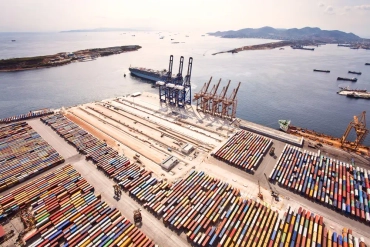


























Spain’s Top 5 Major Ports
 Ports & Routes


Quick Overview
Among Spain’s most important ports for containerized cargo and international logistics are Valencia, Algeciras, Barcelona, Las Palmas, and Bilbao. In 2025, the Spanish state port system moved 556.6 million tonnes and reached a record 18.6 million TEUs, 2.7% more than in 2024, according to provisional year-end data published by Puertos del Estado.
Spain’s Top 5 Important Ports
These five ports handled around 16.1 million TEUs, representing approximately 86% of Spain’s national container traffic. However, the ranking should be clarified: if measured by total cargo volume, Cartagena surpassed Bilbao in 2025, while Bilbao remains strategic because of its role in northern Spain’s industrial economy, its rail connections, and its general cargo and containerized cargo activity.
When arranging ocean freight shipments, you need to consider both the port of origin and the port of destination. The choice often depends on proximity to the loading or delivery point, but it can also have a major impact on cost, transit time, available maritime services, and intermodal connections.
With iContainers, you can compare ocean freight options to find competitive alternatives based on route, cargo type, and available port.
Port of Valencia
The Port of Valencia remains Spain’s leading container port and one of the major hubs in the Mediterranean. In 2025, Valenciaport handled 5,662,661 TEUs, 3.41% more than the previous year, and recorded around 80.1 million tonnes of total cargo traffic.
Its strength is based on a combination of import-export traffic, international transshipment, and connections with the main markets of the Mediterranean, Asia, the Americas, and North Africa. For shippers and freight forwarders, Valencia is especially relevant for containerized goods, industrial products, consumer goods, agri-food cargo, and traffic linked to the Valencian Community and central Spain.
In addition to its importance in container traffic, Valencia stands out for its maritime connectivity and its role as an entry and exit gateway for supply chains that need frequency, capacity, and fast access to the Spanish market.
Port of Algeciras
The Port of Algeciras is Spain’s largest port by total cargo volume. In 2025, it surpassed 100 million tonnes and handled close to 4.74 million TEUs, maintaining its position as one of the major port hubs in the western Mediterranean.
Its location on the Strait of Gibraltar gives it a unique strategic advantage. Algeciras acts as a connection point between Europe, Africa, the Mediterranean, the Atlantic, and the main East-West routes of international maritime trade.
This port is especially important for container transshipment, Ro-Ro traffic, connections with Morocco, and the movement of goods between continents. For many logistics chains, Algeciras is not only an import or export gateway, but also an international redistribution platform.
Port of Barcelona
The Port of Barcelona continues to be one of Spain’s leading ports in terms of volume, traffic diversity, and logistics added value. In 2025, it handled 69.5 million tonnes and around 3.7 million TEUs. Although total container traffic declined, full import and export containers increased, reflecting the strength of foreign trade linked to the industrial and consumer market in northeastern Spain.
Barcelona stands out for its combination of containers, Ro-Ro traffic, automobiles, liquid bulk, general cargo, and high-value logistics activity. It also has a strategic position for connecting Spain with the Mediterranean, central Europe, and Asian markets.
Its terminals, rail connections, and logistics services make it a key option for companies seeking access to the Catalan market, Aragon, southern France, and other industrial areas in northeastern Spain.
Port of Las Palmas
The Port of Las Palmas is one of the major ports in the Mid-Atlantic and a key platform between Europe, West Africa, and the Americas. In 2025, the Port Authority of Las Palmas handled 36.5 million tonnes, 14.96% more, and reached 1,546,389 TEUs, with growth of 16.28%.
Its location in the Canary Islands allows it to act as a port of call, transshipment hub, supply point, ship repair center, and connection point for Atlantic routes. It is also essential for island supply chains and traffic linked to West Africa.
Las Palmas stands out for its role in regional trade, container transit traffic, Atlantic maritime logistics, and vessel services. Its recent growth reinforces its position as one of Spain’s most dynamic ports.
Port of Bilbao
The Port of Bilbao remains the main port in northern Spain and a strategic hub for the industry of the Basque Country, Castile and León, La Rioja, Navarre, and other inland areas of the Iberian Peninsula. In 2025, it handled just over 32 million tonnes, although traffic declined due to temporary factors such as Petronor’s technical shutdown.
In containerized traffic, Bilbao recorded 423,930 TEUs and around 4.79 million tonnes of containerized cargo. It also maintains a strong position in intermodality: rail has a significant share in its container flows, strengthening its role as an efficient port for logistics chains in northern Spain.
Bilbao is especially important for general cargo, containers, liquid and solid bulk, industrial products, automotive cargo, project cargo, and maritime connections with northern Europe, the United Kingdom, Ireland, and Atlantic routes.
Other relevant ports in Spain
In addition to Valencia, Algeciras, Barcelona, Las Palmas, and Bilbao, Spain has other ports of major importance for maritime trade. These include Cartagena, Tarragona, Huelva, Castellón, Vigo, Seville, Málaga, Alicante, the Bay of Cádiz, and Santa Cruz de Tenerife.
Cartagena deserves special mention because in 2025 it surpassed Bilbao in total cargo volume, with more than 34 million tonnes, mainly driven by liquid bulk and energy-related traffic. However, when container logistics, industrial connectivity, and intermodal role are analyzed, Bilbao remains one of the country’s most relevant ports.
Spain retains a strategic position in international maritime transport thanks to its location between the Mediterranean, the Atlantic, Europe, Africa, and the Americas. The diversity of its ports allows the country to serve global routes, regional traffic, industrial supply chains, imports, exports, and transshipment operations.
References
- Puertos del Estado: record figures for general cargo and TEU traffic in 2025
- Valenciaport: growth of the Port of Valencia in 2025
- Diario del Puerto: fourth quarter 2025 statistical report
- Última Hora: Port of Barcelona results in 2025
- RTVC: record figures for the Las Palmas Port Authority in 2025
- Port of Bilbao: progress in connectivity and rail use
- Diario El Canal: investment and growth at the Port of Bilbao
Related Articles